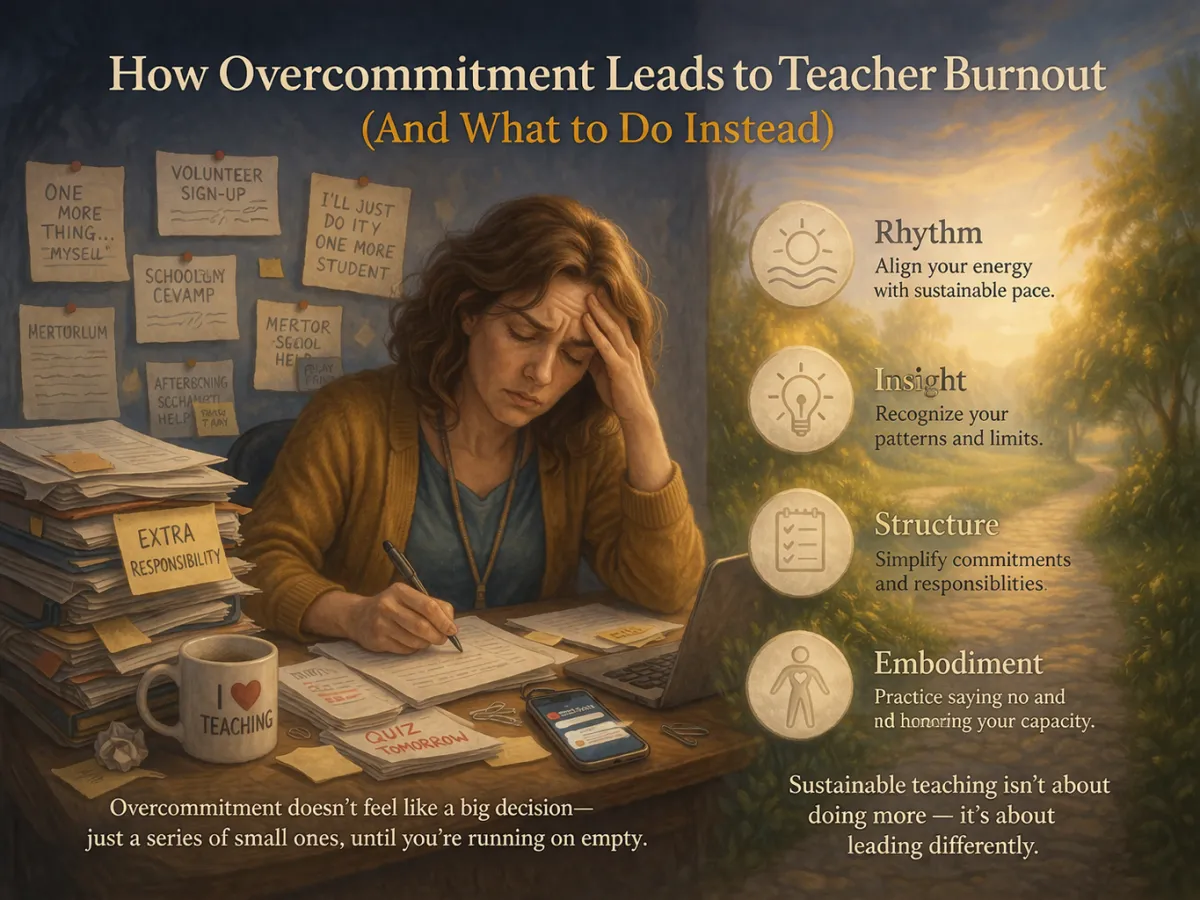
How Overcommitment Leads to Teacher Burnout (And What to Do Instead)
Many educators do not burn out because they lack discipline or resilience.
They burn out because they consistently take on more than their capacity can sustain.
In education, overcommitment often develops gradually. It rarely feels like a conscious decision. Instead, it shows up as small, reasonable choices made over time.
Saying yes to one extra responsibility.
Supporting one more student.
Taking on one additional task because “it’s quicker if I just do it.”
Individually, these decisions seem manageable.
Collectively, they create a workload that exceeds what any one person can carry long-term.
Over time, this pattern leads to chronic stress, reduced recovery, and eventually burnout.
Understanding how overcommitment develops is essential for creating a more sustainable way of working in education.
How Overcommitment Becomes Normal in Education
In many school environments, overcommitment is not only common — it is expected.
Educators are often surrounded by colleagues who are:
Staying late to complete tasks
Taking on additional responsibilities
Supporting others beyond their formal role
Prioritizing work over personal time
This creates a culture where doing more becomes the standard.
For high-achieving women in education, this environment can be particularly challenging.
They are often:
Highly responsible
Trusted by colleagues
Willing to step in when needed
As a result, they are frequently the ones who take on additional work.
Over time, overcommitment stops feeling like a choice and starts feeling like part of the job.
The Hidden Cost of Always Being Reliable
Being reliable is often seen as a strength in education.
However, when reliability turns into constant availability, it begins to carry a cost.
Educators who are always dependable often become:
The person others turn to for help
The one who solves problems
The one who fills gaps when resources are limited
While this builds trust and respect, it also increases workload and responsibility.
The hidden cost includes:
Reduced time for recovery
Increased mental load
Ongoing emotional pressure
Difficulty setting boundaries
Over time, this creates a pattern where the most capable educators carry the heaviest load.
Why Overcommitment Leads to Burnout
Burnout does not happen suddenly.
It develops when there is a consistent mismatch between what is required and what can be sustained.
Overcommitment contributes to this mismatch in several ways:
1. Reduced Recovery Time
When educators take on too much, there is less time available for rest. Evenings and weekends become extensions of the workday.
2. Increased Cognitive Load
More responsibilities mean more decisions, more planning, and more mental processing throughout the day.
3. Emotional Overextension
Supporting students, colleagues, and school systems requires emotional energy. Overcommitment stretches this capacity beyond sustainable limits.
4. Lack of Boundaries
When saying yes becomes the default, it becomes difficult to protect time and energy.
These factors combine to create ongoing stress without adequate recovery.
Over time, this leads to exhaustion, reduced motivation, and decreased capacity to engage with work.
The Difference Between Commitment and Overcommitment
Commitment is essential in education.
It reflects care, professionalism, and dedication.
Overcommitment, however, is different.
Commitment is aligned with capacity
Overcommitment exceeds capacity
A committed educator:
Prioritizes effectively
Maintains boundaries
Protects their energy
An overcommitted educator:
Takes on too much
Struggles to say no
Feels constantly behind
Understanding this distinction is important.
The goal is not to care less about your work.
The goal is to align your commitment with what is sustainable.
How to Reduce Overcommitment Without Guilt
Reducing overcommitment does not require drastic changes.
Small, intentional shifts can create meaningful impact.
1. Pause Before Saying Yes
Create space between a request and your response. This allows you to assess whether the commitment fits your capacity.
2. Identify Non-Essential Tasks
Not every task requires your involvement. Clarifying priorities helps reduce unnecessary workload.
3. Set Clear Limits
Decide in advance how much you are willing to take on. This makes boundary-setting easier in the moment.
4. Recognize That Capacity Is Finite
Time, energy, and attention are limited resources. Protecting them is necessary for long-term effectiveness.
These changes may feel uncomfortable at first, especially for educators who are used to being highly reliable.
However, over time, they create space for recovery and sustainability.
Key Takeaways
Overcommitment develops gradually through repeated small decisions
Education environments often normalize taking on too much
Being highly reliable can lead to increased workload and pressure
Burnout occurs when responsibilities exceed sustainable capacity
Reducing overcommitment requires intentional boundaries and prioritization
Conclusion
Overcommitment is one of the most common and least recognized causes of educator burnout.
It often begins with good intentions, a desire to help, support, and contribute.
However, when these intentions are not balanced with clear limits, they can lead to exhaustion.
Sustainable leadership in education requires more than dedication.
It requires the ability to recognize capacity, set boundaries, and make intentional choices about where energy is invested.
When educators shift from overcommitment to aligned commitment, they create the conditions needed to sustain both their wellbeing and their impact.