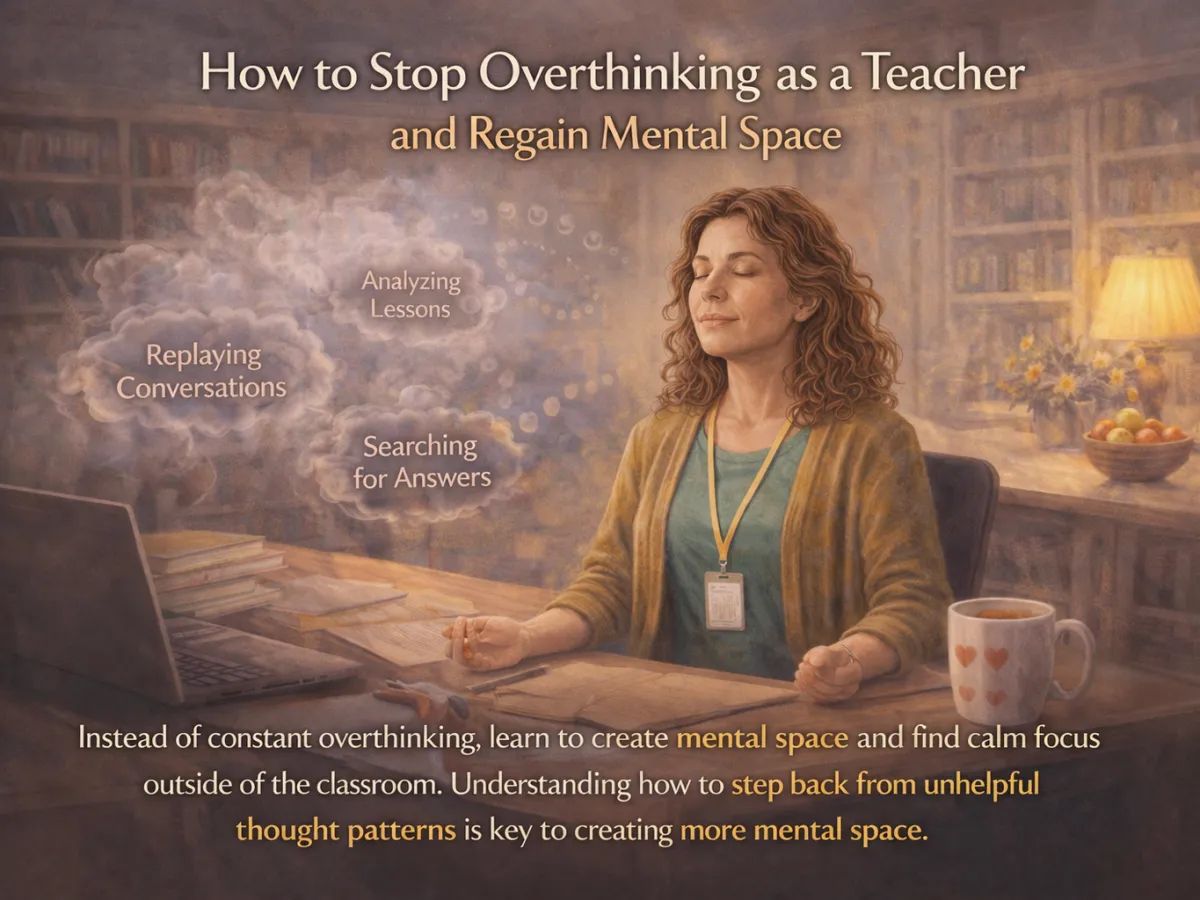
How to Stop Overthinking as a Teacher and Regain Mental Space
Many teachers spend a significant amount of time thinking about their work—even when they are not actively working.
They reflect on lessons, analyze interactions, and consider what could have been done differently.
This level of reflection can be valuable.
However, for many educators, reflection gradually turns into overthinking.
Instead of leading to clarity, thoughts begin to repeat without resolution. The mind revisits the same situations, searches for better answers, and tries to anticipate every possible outcome.
Over time, this creates mental fatigue and reduces the ability to rest.
Understanding the difference between helpful reflection and draining overthinking is key to creating more mental space.
Why Overthinking Is Common in Teaching
Teaching is a profession that involves constant decision-making and responsibility.
Educators regularly:
Make real-time decisions in the classroom
Respond to complex student needs
Navigate interpersonal dynamics
Reflect on their performance
Because these decisions affect others, they often feel significant.
This leads the brain to revisit situations in an attempt to improve future outcomes.
For high-achieving educators, this pattern is even stronger.
They tend to:
Hold high personal standards
Care deeply about doing things well
Feel responsible for results
These qualities support effective teaching, but they also increase the likelihood of overthinking.
When Reflection Turns Into Overthinking
Reflection becomes overthinking when it stops being productive.
Instead of leading to insight or action, thoughts begin to:
Repeat without new conclusions
Focus on past situations that cannot be changed
Expand into multiple “what if” scenarios
Continue long after a decision has been made
At this point, thinking no longer supports improvement.
It starts to consume mental energy without providing value.
The Role of Uncertainty and Control
Overthinking is often driven by a desire for certainty.
Teachers may think:
“Did I handle that correctly?”
“What if I should have done something differently?”
“How will this affect the student?”
These questions reflect a natural desire to do the right thing.
However, many aspects of teaching involve uncertainty.
Not every outcome can be predicted or controlled.
When the brain tries to resolve uncertainty completely, it continues thinking longer than necessary.
How Overthinking Affects Energy and Wellbeing
Overthinking is mentally demanding.
Even though it may not feel like “work,” it uses the same cognitive resources as active problem-solving.
Over time, this can lead to:
Mental fatigue
Difficulty relaxing
Reduced focus
Increased stress
It can also make it harder to be present outside of work.
Instead of engaging fully in personal time, part of the mind remains occupied.
Shifting From Overthinking to Intentional Reflection
The goal is not to stop thinking about your work completely.
Reflection is an important part of growth.
The shift is toward intentional, contained reflection.
This means:
Thinking about situations at specific times
Focusing on what can be learned
Identifying clear next steps
Then allowing the thought process to end
This creates closure instead of repetition.
Practical Ways to Reduce Overthinking
Reducing overthinking requires both awareness and structure.
1. Set Boundaries Around Reflection
Decide when you will reflect on your work—and when you will not.
2. Focus on Actionable Insights
Ask: “What can I do differently next time?”
If no action is needed, the thinking can stop.
3. Limit “What If” Thinking
Recognize when thoughts are moving into hypothetical scenarios that cannot be controlled.
4. Externalize Your Thoughts
Write down reflections to create closure and reduce mental repetition.
5. Redirect Attention
When overthinking begins, gently shift focus to the present moment or another activity.
Letting Go of the Need to Get Everything Right
Many educators overthink because they want to make the best possible decisions.
However, teaching is a complex and dynamic profession.
Not every decision will be perfect.
Accepting this reduces the pressure to analyze every situation repeatedly.
Effective teaching does not require perfection.
It requires consistency, adaptability, and presence.
Creating More Mental Space in Daily Life
When overthinking is reduced, educators often notice:
Greater mental clarity
Improved focus
Increased ability to relax
More presence in personal life
This creates a more sustainable experience of both work and life.
Mental space is not created by thinking more.
It is created by thinking with intention and then allowing space between thoughts.
Key Takeaways
Overthinking is common in teaching due to responsibility and high expectations
Reflection becomes overthinking when it repeats without resolution
The desire for certainty often drives continued thinking
Overthinking reduces mental energy and limits recovery
Intentional reflection and clear boundaries help create mental space
Conclusion
Overthinking is not a sign that you care too much.
It is a sign that your mind is trying to solve problems that may not have clear or immediate answers.
Without boundaries, this process can continue indefinitely, leading to mental fatigue and reduced clarity.
By shifting from constant analysis to intentional reflection, educators can reduce mental strain while still learning and improving.
This creates something that many teachers are missing:
The ability to think clearly when needed and to fully rest when it’s time to step away.
Together we can make this shift, join, www.kickislifedesign.com/info