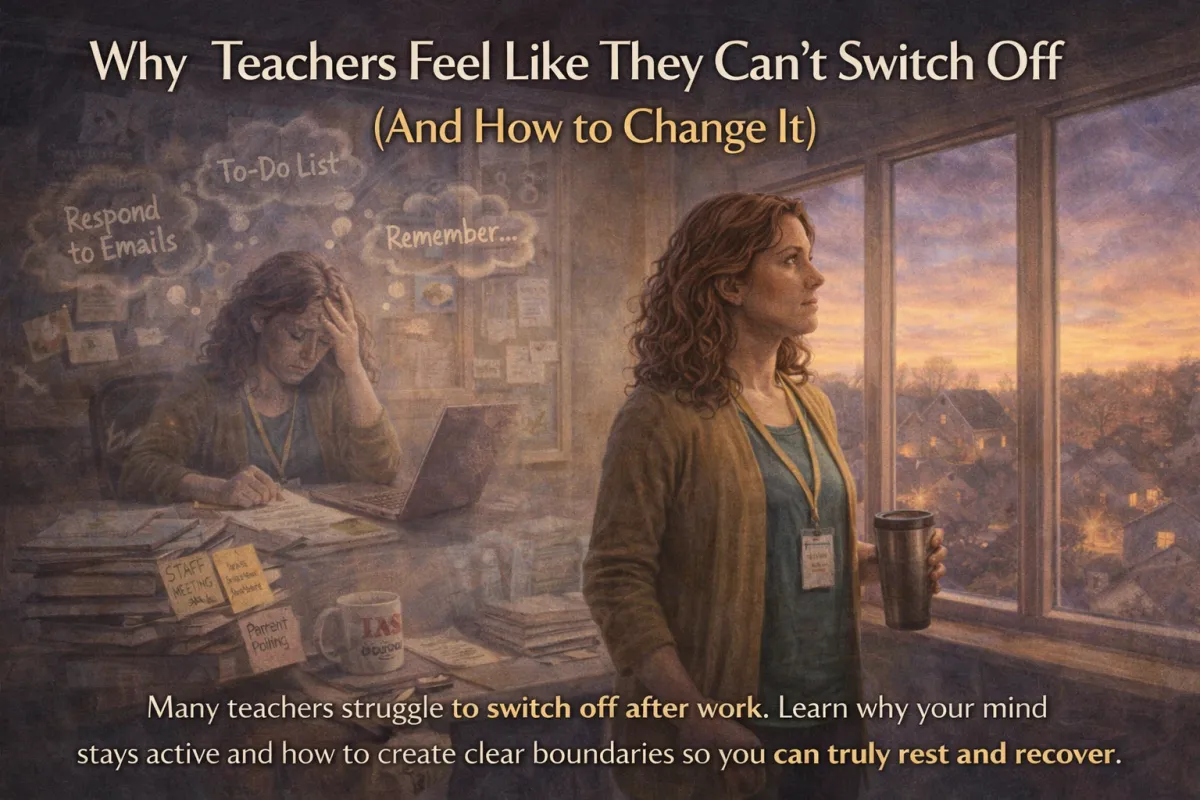
Why Teachers Feel Like They Can’t Switch Off (And How to Change It)
For many educators, the end of the workday does not bring a true sense of closure.
They may leave the classroom, close their laptop, or finish their tasks—but mentally, the work continues.
Conversations replay.
Decisions are reconsidered.
Plans for tomorrow begin forming automatically.
Even during moments meant for rest, part of their attention remains tied to work.
Over time, this creates a persistent feeling of being “on,” even outside working hours.
This experience is not a sign of poor time management.
It is a reflection of how teaching interacts with responsibility, emotional investment, and unfinished cognitive loops.
Understanding why this happens is essential for creating a clear separation between work and personal life.
The Ongoing Mental Loop Many Teachers Experience
One of the most common patterns educators describe is the inability to stop thinking about work.
This mental loop often includes:
Replaying interactions with students or colleagues
Analyzing what could have been handled differently
Planning upcoming lessons or conversations
Anticipating potential challenges
These thoughts are not random.
They are the brain’s attempt to process, resolve, and prepare.
The challenge is that in teaching, there is rarely a clear point where everything feels fully resolved.
As a result, the loop continues.
Why the Brain Doesn’t Naturally Switch Off
The brain is designed to complete what it starts.
When something feels unfinished or uncertain, it continues to return to it.
In education, many aspects of the job remain open-ended:
Student progress is ongoing
Conversations are rarely final
Outcomes are not always predictable
Responsibilities extend beyond a single task
Because of this, the brain does not receive a clear signal that work is “done.”
Instead, it stays in a low-level problem-solving state, even during personal time.
The Role of Responsibility in Keeping the Mind Active
High-achieving educators often carry a strong sense of responsibility.
They care deeply about:
Their students’ wellbeing
The quality of their teaching
Their impact on others
This level of care is valuable, but it also keeps the mind engaged.
When responsibility feels ongoing, the brain treats work as something that must remain active.
This makes it difficult to fully disengage.
Emotional Investment Makes It Harder to Disconnect
Teaching is not only cognitive—it is emotional.
Educators regularly:
Support students through challenges
Manage classroom dynamics
Navigate complex relationships
This emotional involvement strengthens memory and attention.
Situations that carry emotional weight are more likely to stay active in the mind.
This is why certain moments replay more than others.
It is not because something went wrong.
It is because the brain has marked the experience as important.
The Cost of Never Fully Switching Off
When the mind remains partially engaged with work, recovery becomes limited.
This can lead to:
Ongoing mental fatigue
Reduced ability to relax
Lower quality of rest
Increased stress over time
Even when educators are not actively working, their nervous system may still be in a state of alertness.
This reduces the effectiveness of personal time as true recovery.
Creating a Clear Psychological End to the Workday
Switching off requires more than simply stopping work.
It requires creating a clear mental endpoint.
The brain needs to recognize that:
Tasks have been acknowledged
Priorities have been defined
Nothing urgent is being forgotten
Practical ways to create this include:
1. Externalizing Open Loops
Write down unfinished tasks and next steps. This reduces the need for the brain to hold them.
2. Defining “Done for Today”
Instead of aiming to finish everything, define what is complete for the day.
3. Creating a Consistent End-of-Day Ritual
Repeating the same actions signals to the brain that the workday has ended.
Setting Mental Boundaries Around Work
In addition to practical structure, mental boundaries are essential.
This involves deciding:
When work-related thinking is appropriate
When attention should shift to personal life
When work thoughts arise outside of these times, the goal is not to suppress them, but to redirect attention intentionally.
This takes practice, but it becomes easier over time.
Shifting From Constant Engagement to Intentional Engagement
The goal is not to eliminate thinking about work entirely.
Educators will always reflect, plan, and care.
The shift is from constant, automatic engagement to intentional, contained engagement.
Instead of thinking about work all the time, educators create:
Defined times for reflection
Clear boundaries for rest
Structured transitions between roles
This allows both work and personal life to exist without overlapping continuously.
Key Takeaways
Teachers often struggle to switch off due to ongoing mental loops
The brain stays active when tasks feel unfinished or unresolved
Emotional investment strengthens mental engagement with work
Without clear boundaries, recovery becomes limited
Creating structured endings and mental limits supports disengagement
Conclusion
The inability to switch off is not a failure of discipline.
It is a natural response to a role that combines responsibility, emotional investment, and ongoing demands.
However, without intentional boundaries and structure, this pattern can lead to continuous mental engagement and reduced recovery.
By creating clear endpoints, externalizing tasks, and developing mental boundaries, educators can begin to shift from constant connection to intentional disconnection.
This shift allows for something many educators are missing:
The ability to be fully present outside of work—without carrying it with them.